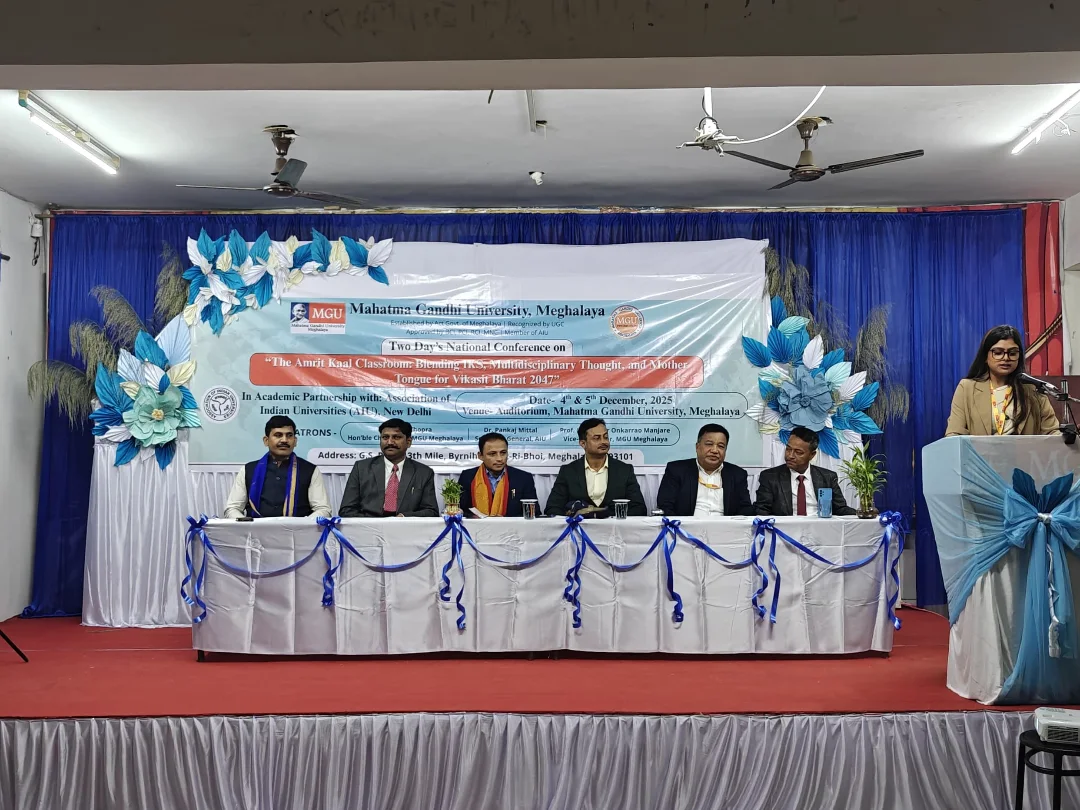

Mahatma Gandhi University, Meghalaya, in collaboration with the Association of Indian Universities (AIU), hosted a two-day national conference on December 4 and 5, 2025, titled “The Amrit Kaal Classroom: Blending IKS, Multidisciplinary Thought, and Mother Tongue for Vikasit Bharat 2047.” The event brought together academics, practitioners and policy thinkers to deliberate on how Indian Knowledge Systems (IKS), multidisciplinary learning and mother-tongue-based education can shape the country’s journey towards a developed India by 2047.
Amrit Kaal Classroom Conference Charts Roadmap for Viksit Bharat 2047
In his inaugural address, Vice-Chancellor Dr. Sagar O. Manjare underlined the strategic importance of the conference theme at this juncture of India’s educational reforms. He stressed that classrooms of the “Amrit Kaal” must go beyond content delivery and evolve into spaces that nurture rootedness in Indian civilisation, scientific temperament and linguistic diversity, while remaining globally competitive. Framing the conference as a “timely academic intervention”, he emphasised that universities now carry a dual responsibility—preserving India’s intellectual heritage and simultaneously preparing students for rapidly transforming knowledge economies.
The Vice-Chancellor acknowledged the institutional and moral support that made the conference possible. The university expressed deep gratitude to Hon’ble Chancellor Dr. Rajan Chopra, Patron of the event, for extending financial support and encouragement, and to Dr. Pankaj Mittal, Secretary General of AIU, whose vision and guidance as Academic/Knowledge Partner shaped the intellectual direction of the deliberations. Their combined support, MGU officials noted, signalled a wider national recognition that the future of higher education must be both innovation-driven and culturally anchored.
Providing strategic academic stewardship, Dr. Mohan Bhattacharya, Advisor, MGU Meghalaya, guided the overall conceptualization of the conference. The core team was led by Convenors Dr. Y. Krishna Reddy (Dean, Allied Health Science) and Dr. Amalesh Adhikary (Dean, Humanities and Social Sciences), reflecting the very spirit of multidisciplinarity the conference sought to promote. They were supported by Co-Convenors Dr. Lanu W. Aimol (Principal, Department of Special Education), Prof. Geeteshwori (Principal, Department of Nursing) and Prof. Lurshai Lyngwa (Associate Dean, Academics), ensuring that perspectives from health sciences, special education, humanities and professional programmes all found space in the dialogue.
Day 1 of the conference, hosted with poise by Alicia Lapang and Parsis Aman (Faculty, Department of English), set a strong tone through the presence of distinguished guests whose careers cut across security, entrepreneurship, law and public policy. The Chief Guest, Shri Thonglenglal Haokip, Deputy Commandant, CRPF, 9th Mile, Guwahati, brought a unique perspective from India’s internal security frontiers. A recipient of the Police Medal for Gallantry awarded by the President of India for his role in an operation in Pulwama, Kashmir, in 2011, and honoured with several DG CRPF Discs and commendation certificates, including from the Directors General of Nagaland and Manipur Police, he personified courage, discipline and public service. His presence underscored that nation-building for 2047 requires not only enlightened classrooms but also secure, stable environments in which ideas can flourish.

The Guest of Honour, Shri Ankur Bezbaruah, entrepreneur and founder of Prakritik Paint as well as Pran Pramukh of the Vishwa Hindu Parishad, highlighted how sustainable entrepreneurship can draw upon local resources, traditional knowledge and community networks. By situating innovation within India’s own ecological and cultural context, his remarks resonated with the conference’s focus on IKS and locally grounded yet globally relevant development models. His intervention pointed to how universities can partner with industry to incubate eco-friendly, affordable solutions that speak to both livelihood creation and environmental responsibility.
Offering the keynote address, Dr. Amarjyoti Sarma, Professor at BRM Government Law College, examined the policy and legal dimensions of integrating mother-tongue education and IKS into mainstream curricula. He drew attention to the need for regulatory clarity, institutional autonomy and academic freedom if universities are to meaningfully redesign syllabi, assessment standards and pedagogical practices in line with national goals such as NEP 2020 and Viksit Bharat 2047. His analysis underscored that without coherent legal frameworks and sustained funding, even the most visionary educational ideas may remain confined to conferences and policy papers.
Adding a governance and public administration perspective, Shri D. S. Malai, Member of the Telecom Advisory Committee, Department of Telecommunications, Ministry of Communication, Government of India, and Founder of HID Foundation, Shillong, linked educational reform to digital inclusion and social equity. Drawing from his experience as former Advisor to the Minister of Education and General Administration Department, Government of Meghalaya, and as former Deputy Chairman, Meghalaya State Health Advisory Board (Health and Family Welfare Department), he stressed that mother-tongue and multidisciplinary education must be supported by robust digital infrastructure and community outreach if they are to reach learners in remote and underserved regions.
The academic core of the conference was anchored by research presentations from teachers, students and research scholars. A total of five presenters participated in offline mode, while eight scholars presented their work online, signalling the hybrid, technology-enabled nature of contemporary academic discourse. The papers explored diverse themes: classroom innovations rooted in IKS, community-linked learning models, language-inclusive pedagogies, health and well-being in the Amrit Kaal classroom, and emerging multidisciplinary frameworks for 21st-century education. Together, they painted a rich picture of how theory, policy and grassroots experimentation are slowly converging.
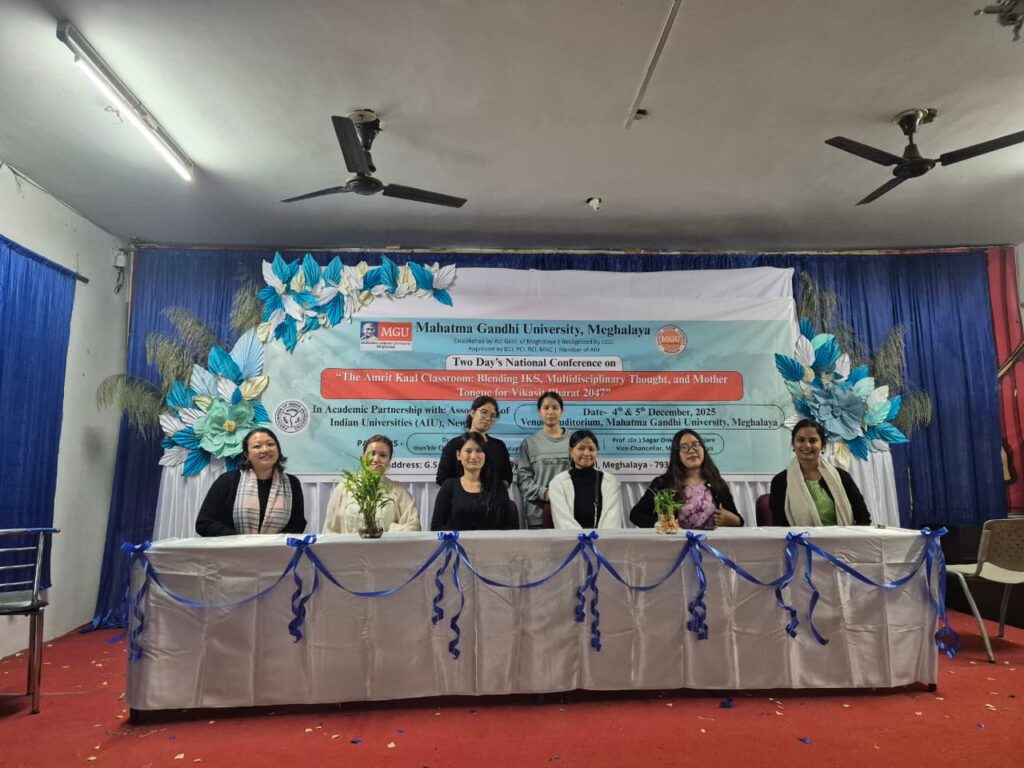
Behind the scenes, the success of the two-day event rested on the meticulous work of a large and diverse organising team. The Organising Committee comprised Dr. Mamata Pandit, Dr. Jayita Baruah, Ms. Champa Burmon, Mr. Rekibur Rahman, Ms. Pynbianghunlang Kurbah, Ms. Miranda B. Marak, Ms. Daily Grace Lamare, Mr. Abhilash Sarma, Mr. Sakir Husain, Ms. Archana Das, Dr. K. P. Sousa, Dr. Priyanka Goswami, Ms. Larisha Syngkli, Ms. Priyanka Bujarbaruah, Mr. Cleanstar Bargayary, Ms. Mayuri Das, Ms. Banashree Saikia, Mr. Dhanmani Choudhury, Ms. Priti Pasha, Mr. Nitumoni Rongpe, Asst. Prof. Babita Rabha and Ms. Baby Debbarma. Their coordinated efforts—from academic scheduling and logistics to hospitality, publicity and technical support—ensured that the conference ran seamlessly and that participants from different states and disciplines experienced the university as a serious, emerging hub of higher learning.
The outcomes envisioned by Mahatma Gandhi University, Meghalaya, extend far beyond the two days of deliberation. The university announced that the key recommendations of the conference will be compiled and submitted as a white paper to the University Grants Commission (UGC), the Ministry of Education (MoE), Government of India, and the Government of Meghalaya. This move is aimed at ensuring that the insights generated—on IKS integration, mother-tongue pedagogy, and multidisciplinary curriculum design—are not confined to a single campus, but inform broader policy discussions and potential reforms at state and national levels.
In addition, all research papers submitted by teachers, students and research scholars will be published in book form, creating a consolidated resource for policymakers, academics and practitioners. By archiving these contributions, the university seeks to build a reference volume that can guide future curricular reforms, institutional innovations and region-specific educational experiments. It also offers an important platform for early-career scholars whose work often struggles to find visibility in mainstream academic publishing.
Amrit Kaal Classroom Conference Charts Roadmap for Viksit Bharat 2047
As the conference concluded, one clear message emerged: the vision of Viksit Bharat 2047 cannot be achieved solely through infrastructure or economic growth. It requires classrooms that are intellectually rigorous, culturally confident and socially inclusive—spaces where Indian Knowledge Systems converse with modern science, where the mother tongue is an instrument of empowerment, and where multidisciplinary thinking becomes everyday practice. Through this national conference, Mahatma Gandhi University, Meghalaya, has signalled its intention to be an active participant—and not a passive observer—in shaping that educational future.

 By
By