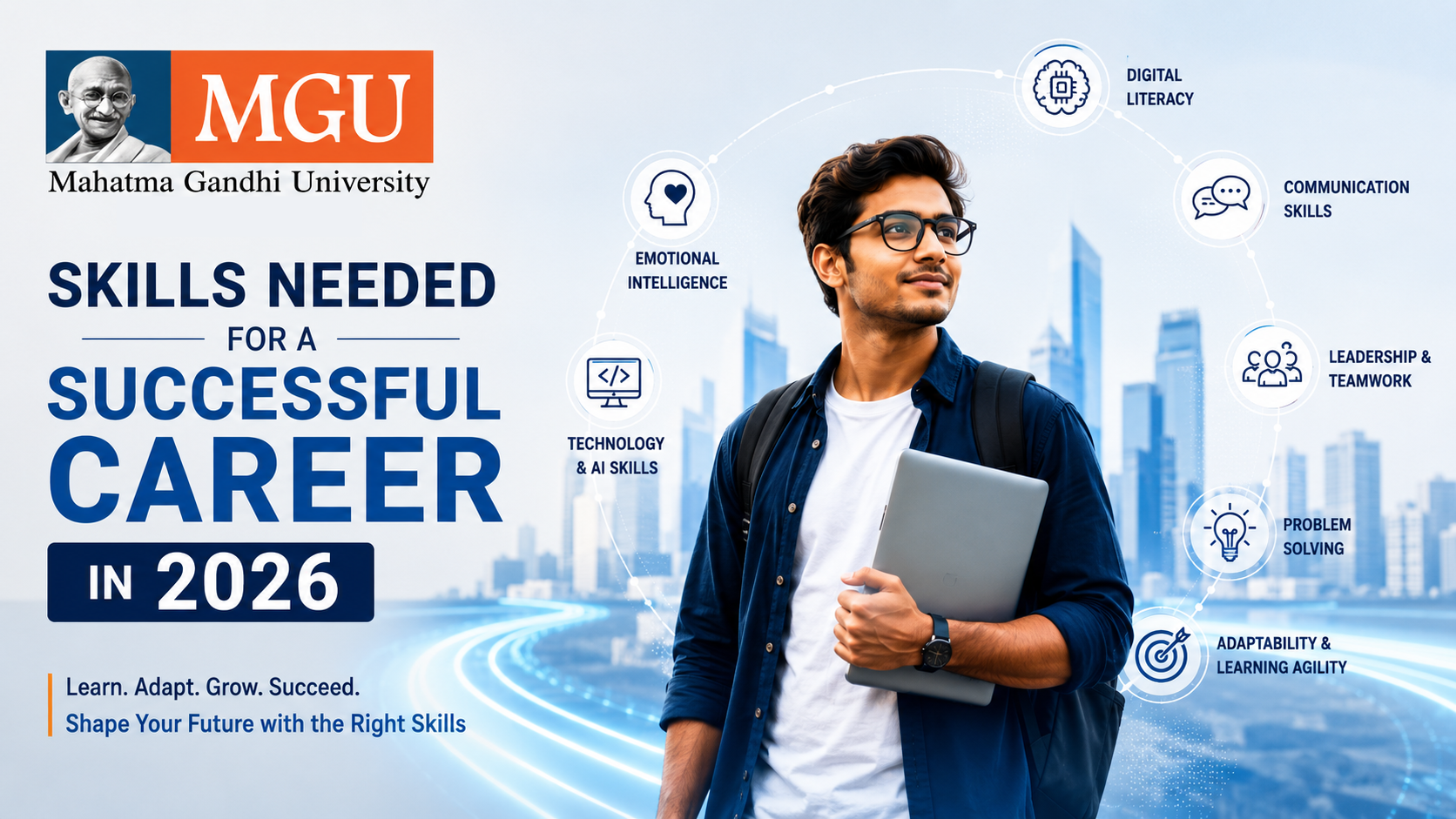

Skills Needed for a Successful Career in 2026: A university degree can open the door to a career, but in 2026, skills are what can help students move forward once that door opens.
The workplace is changing faster than ever. Artificial Intelligence (AI), automation, digital tools, remote collaboration, and changing business needs are influencing the way people work across industries. As a result, employers are increasingly looking for graduates who can combine academic knowledge with practical abilities, communication, problem-solving, and the confidence to learn new things.
For students, this raises an important question:
What skills needed for a successful career in 2026?
The answer is not limited to technical knowledge. A successful career increasingly requires a combination of digital skills, human skills, professional abilities, and a mindset of continuous learning.
According to the World Economic Forum’s Future of Jobs Report 2025, analytical thinking remains one of the most important core skills for employers, while AI and big data, networks and cybersecurity, and technological literacy are among the fastest-growing skill areas. At the same time, creative thinking, resilience, flexibility, leadership, and lifelong learning continue to be valuable.
Let’s look at the skills students should focus on as they prepare for the world of work in 2026 and beyond.
Why Are Career Skills Important in 2026?
Skills Needed for a Successful Career in 2026: For a long time, students were often told that earning a degree was the primary step toward a successful career.
A degree is still important. It provides subject knowledge, academic understanding, and a foundation for professional development.
However, today’s employers may also want to know:
- Can you solve real-world problems?
- Can you communicate your ideas clearly?
- Can you work with digital tools?
- Can you adapt to new technology?
- Can you work effectively with a team?
- Can you learn something new when the situation demands it?
These questions are becoming increasingly relevant as technology changes the nature of many jobs.
The good news is that students do not need to master every new technology. Instead, they need to develop the ability to learn, adapt, apply knowledge, and keep improving.
Top Skills Needed for a Successful Career in 2026
1. AI Literacy
Artificial Intelligence is no longer limited to technology companies.
AI tools are being used in areas such as marketing, finance, healthcare, education, design, research, customer service, software development, and business operations.
This makes AI literacy one of the most useful skills for students in 2026.
AI literacy does not necessarily mean becoming an AI engineer. It means understanding:
- How AI tools work at a basic level
- How to use AI responsibly
- How to write effective prompts
- How to verify AI-generated information
- How AI can improve productivity
- What limitations and risks AI systems have
For example, a management student may use AI for research and data analysis, while a media student may use it for brainstorming and content planning.
The important thing is not simply knowing how to use AI.
The real advantage comes from knowing when, why, and how to use it effectively.
2. Analytical Thinking and Problem-Solving
Technology can provide information quickly, but professionals still need to understand that information and make sensible decisions.
That is why analytical thinking and problem-solving remain highly valuable career skills.
Analytical thinking allows students to:
- Break complex problems into smaller parts
- Examine information carefully
- Identify patterns
- Compare possible solutions
- Make logical decisions
- Evaluate results
The World Economic Forum identifies analytical thinking as one of the most important core skills for employers.
Students can develop this ability through case studies, research projects, practical assignments, debates, competitions, and real-world problem-solving activities.
3. Communication Skills
You may have excellent knowledge, but if you cannot communicate your ideas effectively, that knowledge can be difficult to showcase.
Communication skills remain essential for almost every career.
Good communication includes:
- Speaking clearly
- Professional writing
- Presentation skills
- Active listening
- Email communication
- Public speaking
- Interpersonal communication
Communication is particularly important during interviews, presentations, meetings, client interactions, and teamwork.
And remember, good communication is not about using complicated English.
It is about making your message clear and easy to understand.
4. Digital Literacy
Almost every modern workplace uses digital technology in some form.
Therefore, basic digital literacy is no longer something only technology students need.
Depending on their field, students should become comfortable with:
- Productivity software
- Digital collaboration tools
- Cloud platforms
- Online research
- Digital communication
- Data tools
- Industry-specific software
- Basic cybersecurity practices
Digital literacy also means being comfortable with learning new tools.
You do not need to know every software platform available today. What matters is developing the confidence to learn and adapt when a new tool becomes part of your workplace.
Skills Needed for a Successful Career in 2026
5. Creative Thinking
Creativity is not only for artists, designers, or content creators.
Businesses need people who can think differently, find new approaches, and develop innovative solutions.
Creative thinking can help professionals:
- Generate new ideas
- Improve existing processes
- Solve problems differently
- Develop new products
- Create better customer experiences
- Identify new opportunities
Even as AI becomes more capable of generating content and ideas, human creativity remains valuable because people still need to understand context, purpose, emotions, and real-world needs.
6. Adaptability and Flexibility
One of the biggest lessons from today’s job market is that change is normal.
A technology that is popular today may be replaced by something new tomorrow. Job roles can evolve, companies can restructure, and industries can introduce new requirements.
Students who develop adaptability and flexibility can be better prepared for these changes.
Adaptability means being willing to:
- Learn new skills
- Accept feedback
- Try new approaches
- Work with new technologies
- Adjust to changing situations
- Learn from mistakes
Instead of asking, “What if my industry changes?”, students should develop the mindset:
“If my industry changes, I can learn and adapt.”
That mindset can become a significant career advantage.
Skills Needed for a Successful Career in 2026
7. Teamwork and Collaboration
Very few modern projects are completed entirely by one person.
Professionals often work with colleagues from different departments, backgrounds, and areas of expertise.
This makes teamwork an essential career skill.
Effective collaboration involves:
- Listening to others
- Sharing responsibilities
- Respecting different viewpoints
- Meeting deadlines
- Giving and receiving feedback
- Resolving disagreements professionally
- Working toward a common goal
University projects, group presentations, clubs, competitions, internships, and student activities can all provide opportunities to develop collaboration skills.
Skills Needed for a Successful Career in 2026
8. Leadership and Decision-Making
Leadership is not simply about becoming a manager.
A student can demonstrate leadership by taking responsibility for a project, helping a team stay organised, making decisions, or supporting others during challenging situations.
Important leadership skills include:
- Decision-making
- Accountability
- Communication
- Team management
- Responsibility
- Motivation
- Conflict resolution
Students who develop leadership skills early can become more confident when they enter professional environments.
9. Data Literacy
We live in a data-driven world.
Companies use data to understand customers, evaluate performance, forecast trends, manage finances, and make strategic decisions.
You do not have to become a data scientist to benefit from data literacy.
Students should understand the basics of:
- Reading charts and graphs
- Understanding data trends
- Interpreting basic statistics
- Using spreadsheets
- Identifying useful information
- Making decisions based on evidence
Data literacy can be valuable in almost every sector, including business, healthcare, education, marketing, finance, technology, and public services.
10. Cybersecurity Awareness
As more work and communication move online, protecting digital information becomes increasingly important.
Students should develop basic cybersecurity awareness even if cybersecurity is not their career field.
This includes understanding:
- Strong password practices
- Two-factor authentication
- Phishing attacks
- Suspicious links
- Data privacy
- Secure online behaviour
- Safe use of public networks
Cybersecurity and networks are among the technology skill areas expected to grow in importance, according to the World Economic Forum.
Skills Needed for a Successful Career in 2026
11. Emotional Intelligence
Professional success is not only about technical ability.
People also need to understand how to work with others, manage pressure, respond to feedback, and handle disagreements.
This is where emotional intelligence becomes important.
It includes:
- Self-awareness
- Empathy
- Active listening
- Emotional control
- Relationship management
- Conflict management
A technically skilled professional who cannot work effectively with others may struggle in a team environment.
On the other hand, someone who combines professional expertise with strong interpersonal skills can become a valuable part of an organisation.
12. Time Management
University students often have to balance classes, assignments, projects, examinations, internships, extracurricular activities, and personal responsibilities.
Learning to manage time effectively can prepare students for professional life.
Good time management involves:
- Setting priorities
- Creating realistic deadlines
- Breaking large tasks into smaller steps
- Avoiding unnecessary distractions
- Planning ahead
- Reviewing progress regularly
Being busy is not the same as being productive.
Good time management is about using your time intentionally.
Skills Needed for a Successful Career in 2026
13. Lifelong Learning
Perhaps the most important career skill in 2026 is the ability to keep learning.
The skills required for a job today may change over time. New technologies may appear, industries may evolve, and employers may expect different capabilities.
The World Economic Forum highlights curiosity and lifelong learning among the skills that will remain important as the workplace changes.
Students should therefore develop a simple habit:
Learn → Practise → Apply → Improve → Learn Again
This approach can help them stay relevant throughout their careers.
Hard Skills vs Soft Skills: Which Is More Important?
Students sometimes ask whether they should focus on technical skills or soft skills.
The better answer is: you need both.
Hard Skills
These are skills directly related to a particular profession, such as:
- Programming
- Accounting
- Data analysis
- Laboratory techniques
- Digital marketing
- Financial analysis
- Graphic design
- Engineering skills
Soft Skills
These help you work effectively with people and adapt to professional situations:
- Communication
- Teamwork
- Leadership
- Problem-solving
- Adaptability
- Emotional intelligence
- Time management
In 2026, a strong career profile increasingly looks like:
Academic Knowledge + Technical Skills + Digital Skills + Human Skills + Practical Experience
Skills Needed for a Successful Career in 2026
How Can Students Develop Career Skills While Studying?
Skills cannot be developed only by reading about them.
They require practice.
Students can use their university years to:
Participate in Projects
Projects allow students to apply classroom knowledge to practical situations.
Take Internships
Internships can provide exposure to professional environments and workplace expectations.
Attend Workshops
Workshops and industry sessions can introduce students to current tools, practices, and career trends.
Work on Presentations
Presentations can improve communication, confidence, and public-speaking abilities.
Learn Additional Digital Skills
Students can explore AI tools, data analysis, digital marketing, coding, design, or other skills relevant to their chosen career.
Build a Portfolio
Instead of collecting certificates alone, students can document projects, assignments, presentations, research work, internships, and other achievements.
A portfolio can help demonstrate what you can actually do, not just what you have studied.
Skills Needed for a Successful Career in 2026
How Mahatma Gandhi University Helps Students Prepare for the Future
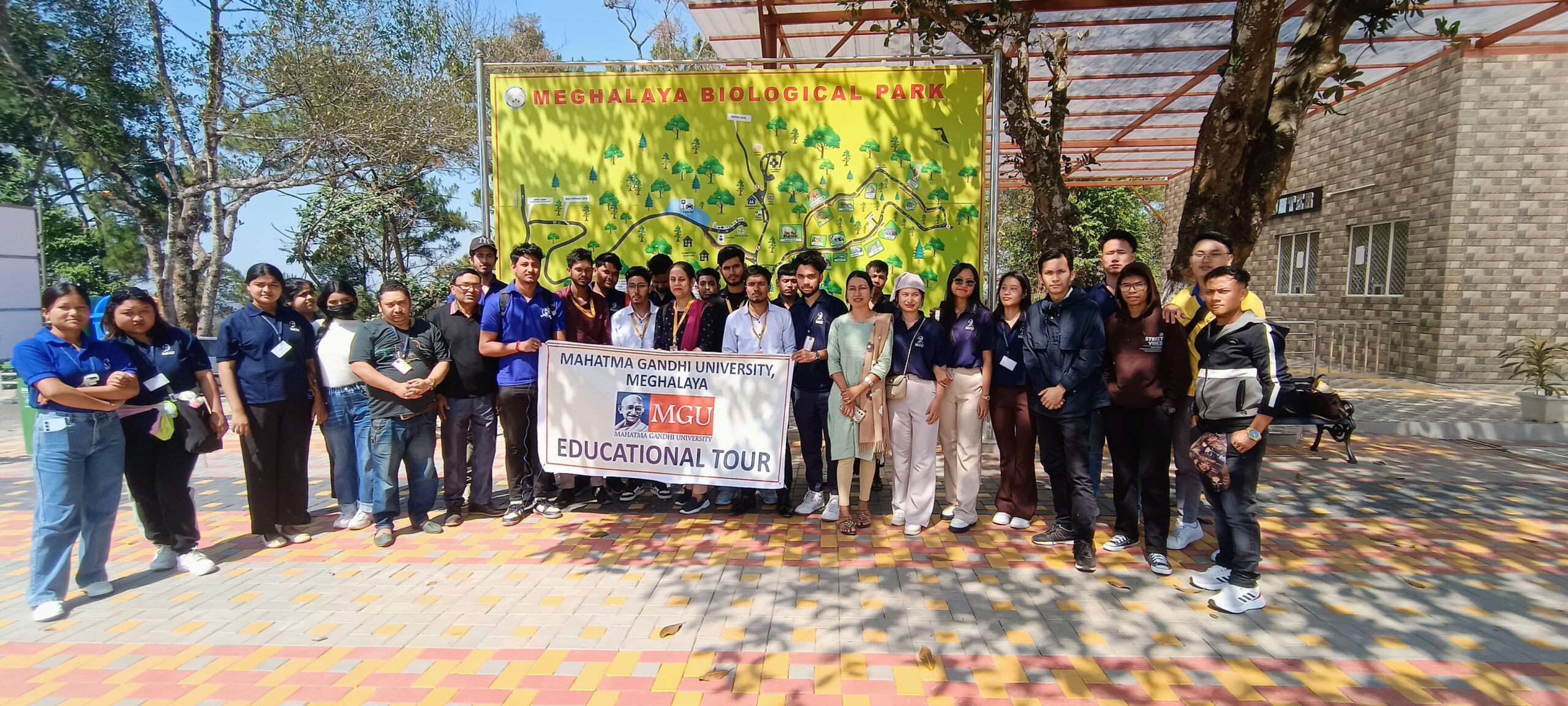
At Mahatma Gandhi University (MGU), Meghalaya, education is supported by academic programmes as well as learning resources and skill-development initiatives.
MGU lists facilities such as an LMS, e-learning and e-books, e-library, computer labs, video lectures, industry speakers, IT simulations, skill-development programmes, and student placement services.
The university also provides skill-development opportunities covering areas such as technology, management, communication, banking and finance, media, animation, software development, data-related areas, and emerging technologies.
MGU’s career-support initiatives also focus on areas such as skill building, soft-skills training, internships, industrial visits, certifications, and placement-related activities.
For students, this kind of learning environment can help connect academic education with the practical skills increasingly expected in professional life.
Skills Needed for a Successful Career in 2026
What Skills Should Students Prioritise in 2026?
If you are overwhelmed by the long list of skills, start with a simple combination.
For Every Student
Communication + Problem-Solving + Digital Literacy + AI Literacy + Adaptability
Then add skills based on your career:
Management:
Data analysis + Leadership + Business communication
Technology:
Programming + AI + Cybersecurity + Problem-solving
Commerce & Finance:
Financial analysis + Data skills + Digital tools
Healthcare:
Technical knowledge + Communication + Digital health awareness + Empathy
Media & Communication:
Content creation + AI tools + Communication + Creativity
Law:
Research + Analytical thinking + Communication + Digital literacy
The exact combination will vary from one career to another.
Can Skills Replace a University Degree?
No. Skills and education should not be treated as competing alternatives.
A university education can provide:
- Subject knowledge
- Academic foundation
- Structured learning
- Research exposure
- Practical opportunities
- Professional development
Skills help students apply that knowledge in real-world situations.
The strongest approach is therefore not:
Degree OR Skills
but:
Degree + Skills + Experience
Skills Needed for a Successful Career in 2026
The Future Belongs to Adaptable Professionals
The world of work in 2026 is not asking students to predict exactly what the future will look like.
Instead, it is asking them to become prepared for change.
AI may transform certain roles. New industries may emerge. Existing jobs may require new tools. Some skills may become less relevant while others become increasingly valuable.
Students cannot control every change in the job market.
But they can control how prepared they are for it.
Building strong communication, analytical thinking, digital literacy, AI awareness, creativity, teamwork, adaptability, leadership, and lifelong learning habits can give students a stronger foundation for the future.
Final Thoughts
Skills Needed for a Successful Career in 2026: A successful career in 2026 is unlikely to depend on one skill alone.
It will increasingly depend on how well a person can combine knowledge, technology, human abilities, and continuous learning.
Your degree gives you a foundation. Your skills help you apply that knowledge. Your experiences teach you how to handle real situations. And your willingness to keep learning helps you stay prepared for what comes next.
For students at Mahatma Gandhi University, the university years can be an opportunity to build this combination—not only through academics, but also through projects, skill-development activities, digital learning, industry exposure, internships, and career-focused initiatives.
Because in the end, a successful career is not simply about what you studied.
It is about what you learned to do with what you studied.
Frequently Asked Questions
What are the most important skills needed for a successful career in 2026?
The most important skills include AI literacy, analytical thinking, communication, digital literacy, creativity, adaptability, teamwork, leadership, data literacy, emotional intelligence, and lifelong learning.
Is AI a necessary skill for students in 2026?
Basic AI literacy is becoming increasingly useful across many industries. Students do not necessarily need to become AI specialists, but understanding how to use AI tools responsibly can improve productivity and adaptability.
Which soft skills are important for career success?
Communication, teamwork, leadership, problem-solving, adaptability, emotional intelligence, active listening, and time management are among the most valuable soft skills.
Skills Needed for a Successful Career in 2026
Should students focus on technical skills or soft skills?
Students should develop both. Technical skills help them perform profession-specific tasks, while soft skills help them communicate, collaborate, solve problems, and adapt to changing workplace situations.
How can students develop career skills while studying?
Students can develop career skills through projects, internships, workshops, presentations, competitions, certifications, industry interactions, student activities, and practical assignments.
Why is lifelong learning important for career success?
Technology and workplace requirements continue to change. Lifelong learning helps professionals update their knowledge and remain adaptable throughout their careers.
How does Mahatma Gandhi University support student skill development?
Mahatma Gandhi University provides learning resources and skill-development and career-support initiatives that include digital learning resources, computer facilities, industry interaction, skill-building, soft-skills training, internships, and placement-related activities.
Best Online MBA for Working Professionals India | 2026 Guide by VCampus

 By
By